
Insights Blog
Cold Chain Packaging for Food Brands: Your Strategy Guide
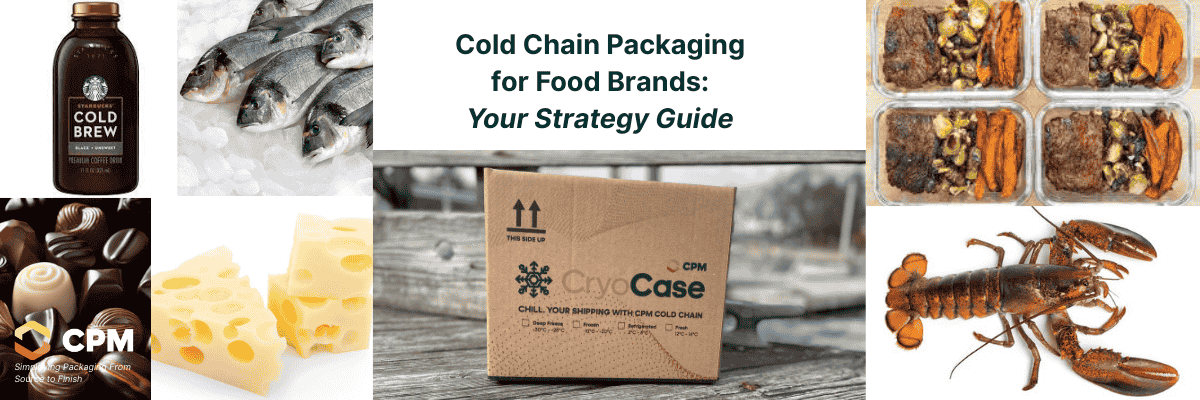
Shipping proteins, seafood, meal kits, and perishables direct to consumer? Get your cold chain strategy right the first time.
The DTC food market is unforgiving. One temperature failure doesn’t just ruin a shipment—it damages reviews, retention, and brand equity. Whether you’re shipping Wagyu steaks, fresh lobster, meal kits, gourmet pet food, or nutraceuticals, your cold chain packaging must perform flawlessly.
Here are the three critical decisions every food company must nail:
1. Packout Strategy: Build In-House or Partner?
The Space & Personnel Reality
Most food brands already have refrigerated storage, but that’s not the real constraint. The real bottlenecks are:
Freezer Capacity for Refrigerants: Some gel packs require 48 hours at -10°F to 0°F (-23°C to -18°C) to pre-condition properly. That’s 500-2,000 sq ft of dedicated freezer space that’s always occupied, cycling refrigerants 2+ days ahead of packout. If you’re tight on freezer space or using it for product storage, refrigerant pre-conditioning becomes a logistics puzzle competing with revenue-generating inventory.
Kitting & Assembly Labor: Cold chain pack out isn’t just dropping products in boxes. Each shipment requires proper insulation fitting, correct refrigerant load and positioning, product arrangement to optimize thermal performance, and quality verification. During peaks (holidays, promotions), you may need 2-3x capacity.
Timing Complexity: Managing the 48-hour pre-conditioning cycle while balancing order volumes, freezer capacity, and labor availability creates operational friction. Miss the refrigerant cycle window and orders slip. Slipping orders can impact reviews and customer retention.
Quick Decision Framework
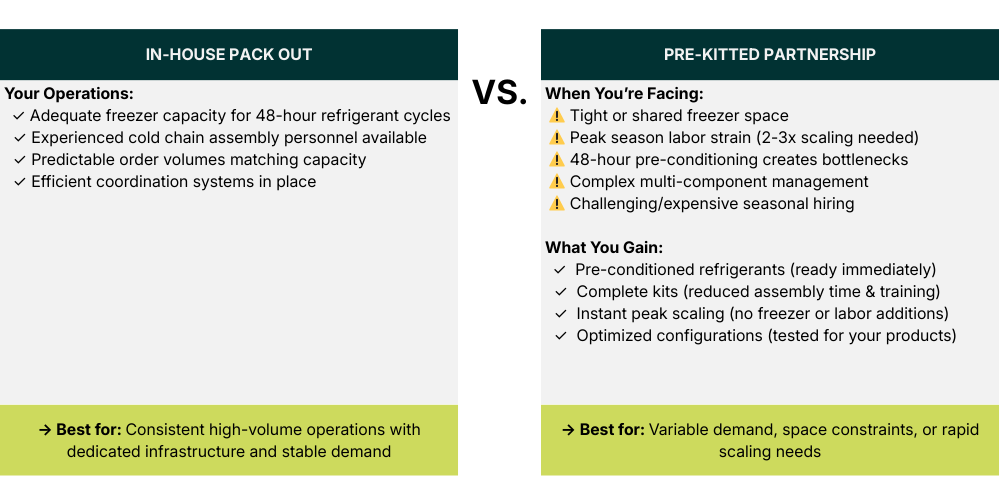
Key Insight: Most food companies don’t lack refrigerated storage—they lack the freezer capacity, labor bandwidth, and coordination systems to efficiently manage cold chain packout at scale. Pre-kitted solutions eliminate these operational bottlenecks.
2. Shipping with Confidence: Getting Configuration Right
There’s no one-size-fits-all cold chain solution, with every shipment requiring balancing of multiple variables.
The Four Critical Variables
I. Payload Mass & Thermal Properties
Different products need different strategies:
- High thermal mass (steaks, whole fish): Retain temperature well, need adequate refrigerant
- Low thermal mass (breads, pasta): Quick to warm, require light refrigerant loading
- Frozen or Refrigerated: Frozen products require 50-100% more refrigerant capacity than fresh products
II. Transit Duration
| Duration | Strategy | Cost/Risk Balance |
| 24 hours | Standard configuration, overnight shipping | Lower refrigerant, higher shipping costs |
| 36 hours | Universal insulation & refrigerants | Best cost/performance balance |
| 48 hours | Enhanced refrigerant, upgraded insulation | Requires validation, weather-dependent |
| 72+ hours | Maximum refrigerant, premium insulation requirements | High-risk, avoid Thursdays & Fridays |
III. Shipping Lane & Season
Geography and timing dramatically impact requirements. Summer shipments to Phoenix (110°F/43°C ambient) need 50-100% more refrigerant than the same route in winter. Rural routes mean longer transit and more handling points. Weekend shipping creates risk—Friday orders often don’t arrive until Monday, creating 72+ hour transit windows that require premium configurations.
| Temp Target | Products | Refrigerant Strategy | Recommended Gel/Cold Source Temp |
| Frozen (≤0°F / ≤-18°C) | Ice cream, frozen meals, proteins | Dry ice or high-volume gel packs | -10°F to 0°F (-23°C to -18°C) |
| Refrigerated (32–40°F / 0–4°C) | Seafood, meal kits, fresh meats, dairy | Standard gel packs | 28°F to 32°F (-2°C to 0°C) |
| Cool (40–50°F / 4–10°C) | Cheese, beverages, nutraceuticals, chocolate | Moderate gel pack loading | 32°F to 40°F (0°C to 4°C) |
| Ambient (59–77°F / 15–25°C) | Shelf-stable foods, dry goods | Seasonal/minimal refrigerant | Conditioned packs ~50–68°F (10–20°C) |
Temperature Monitoring: When & Why
Three monitoring options exist:
- Single-use indicators ($1-3) show if temperature thresholds were exceeded
- Data loggers ($15-30, reusable) provide complete temperature profiles throughout transit
- Smart systems ($20-50+) offer real-time alerts with GPS tracking
Use monitors when testing new products or configurations, shipping high-value items (Bluefin Tuna or Wagyu), validating performance in extreme weather, or troubleshooting claims and returns.
Smart Monitoring Strategy: Monitor 5-10% of shipments for validation, then reduce once performance is proven. This statistical sampling provides confidence without adding cost to every shipment.
3. Sustainability: Brand Expectation, Not Optional Feature
The Consumer Reality
Today’s food consumers expect environmental responsibility: 78% consider sustainability when buying food, 64% will pay more for sustainable packaging, and negative reviews increasingly cite “excessive” or “non-recyclable” packaging. Social media amplifies both positive and negative unboxing experiences, making packaging a brand-defining moment.
The EPS Problem
EPS (Styrofoam) foam coolers dominated cold chain for decades due to superior insulation (R-4 to R-5), lightweight properties that minimize shipping costs, and low cost ($3-6 per cooler). But that advantage is disappearing fast.
EPS Hurts Brands: EPS (commonly known as Styrofoam) is not curbside recyclable (requires special drop-off that consumers rarely use), breaks into messy pieces that frustrate customers, is perceived as cheap and misaligned with premium food brand positioning, is petroleum-based with no biodegradability, and faces growing bans in cities and states.
The Math: Any material savings with EPS versus sustainable alternatives are offset by negative reviews, lost customers, and long-term brand damage. Premium food brands can’t afford the perception mismatch.
The Modern Solution: Fiber-Based Insulation
Fiber-based insulation materials have evolved to match or exceed EPS performance while solving the sustainability problem:
Performance: R-3.5 to R-4 insulation values rival EPS, validated across temperature ranges and transit durations. Properly configured fiber systems reliably maintain frozen, fresh, and cool temperature targets.
Sustainability: 100% curbside recyclable in standard cardboard recycling streams. Many options are also compostable or made from recycled materials (denim, cotton, paper pulp), creating a true circular economy story.
Brand Alignment: Premium feel that matches your product quality. Creates positive unboxing experiences that customers share on social media. Future-proof against tightening regulations and consumer expectations.
Cost Reality: Yes, fiber-based solutions cost more than EPS upfront. But the total cost equation includes fewer negative reviews, higher customer retention, protection of premium brand positioning, and elimination of regulatory risk. For brands selling $50-150+ food shipments, the incremental cost is negligible compared to customer lifetime value.
Building the Complete Cold Chain System
Modern sustainable cold chain solutions go beyond just insulation:
Thermal Bags & Liners: Recyclable poly bags or thermal barriers provide waterproofing and additional temperature protection. These work synergistically with fiber insulation to extend performance, which is especially critical for high-moisture products like seafood.
Plant-Friendly Refrigerants: Bio-based gel packs and plant-derived phase change materials eliminate petroleum dependency while maintaining performance. Some options are even compostable after use.
Dry Ice Options: For frozen shipments requiring extended transit (72+ hours) or extreme summer conditions, dry ice remains the most effective solution. Proper packaging design integrates dry ice safely while maintaining sustainability in other components.
System Integration: The key is optimizing how these elements work together. Fiber insulation + thermal liner + properly loaded refrigerants create a system that outperforms individual components while maintaining sustainability credentials.
Reality Check: [Internal Link: sustainable packaging] Sustainable cold chain isn’t about making compromises—it’s about building smarter systems. Modern fiber-based solutions deliver the performance premium brands need while aligning with consumer values and regulatory trends. The “we can’t afford to be sustainable” argument doesn’t hold up when you factor in brand value and customer retention.
Your Cold Chain Partner Strategy
Cold chain is complex and constantly evolving. New materials and refrigerant technologies emerge regularly, carrier performance and routes change, weather patterns are increasingly unpredictable, regulations around packaging tighten, and consumer expectations continue rising.
[Internal Link: 3PL services] The right cold chain partner delivers pre-validated configurations for your specific products, pre-conditioned refrigerants ready for immediate packout (no 48-hour wait), access to the latest sustainable solutions without R&D investment, temperature testing and validation to optimize performance, scalability during peak seasons without capital investment, and ongoing optimization as your business and solutions evolve.
The Evolution Factor: Your cold chain strategy should improve over time based on data, customer feedback, and new innovations. A strong partner helps you stay ahead rather than constantly playing catch-up.
Getting Started: Three Action Steps
1. Audit Your Current Situation – Calculate true costs of in-house packout including space, labor, equipment, and energy. Identify your biggest pain points around speed, scalability, claims, or sustainability. Determine your volume patterns and peak season multipliers.
2. Define Your Requirements – Document your product categories and thermal properties, transit durations and shipping lanes, temperature targets (frozen, fresh, cool, ambient), and sustainability commitments tied to brand positioning.
3. Test and Validate – Start with temperature monitoring on 10-20% of shipments, gather customer feedback systematically, track claims and analyze root causes, then iterate based on data rather than assumptions.
The Bottom Line
Cold chain packaging for food isn’t a “set it and forget it” operation. Success requires understanding the technical variables that impact performance, making smart build-vs-partner decisions based on your actual capacity, balancing cost with performance and sustainability, and committing to continuous optimization as your business grows.
The companies winning in DTC food delivery consider more than cost. They have the right strategy, backed by the right partner.
Ready to optimize your cold chain strategy? Contact CPM Solutions—we’ve helped food brands from artisan seafood to premium pet food ship with confidence.
About CPM Solutions
CPM Solutions specializes in cold chain packaging, fulfillment, and logistics for food brands. From sustainable packaging design to pre-kitted solutions and full 3PL services, we help companies ship perishables with confidence.